The Retool app your plant runs on has one maintainer, and he just gave notice
Internal tools are the admin screens, dashboards, and approval flows that run a Murfreesboro plant or distribution floor without a packaged product doing it.
On this page
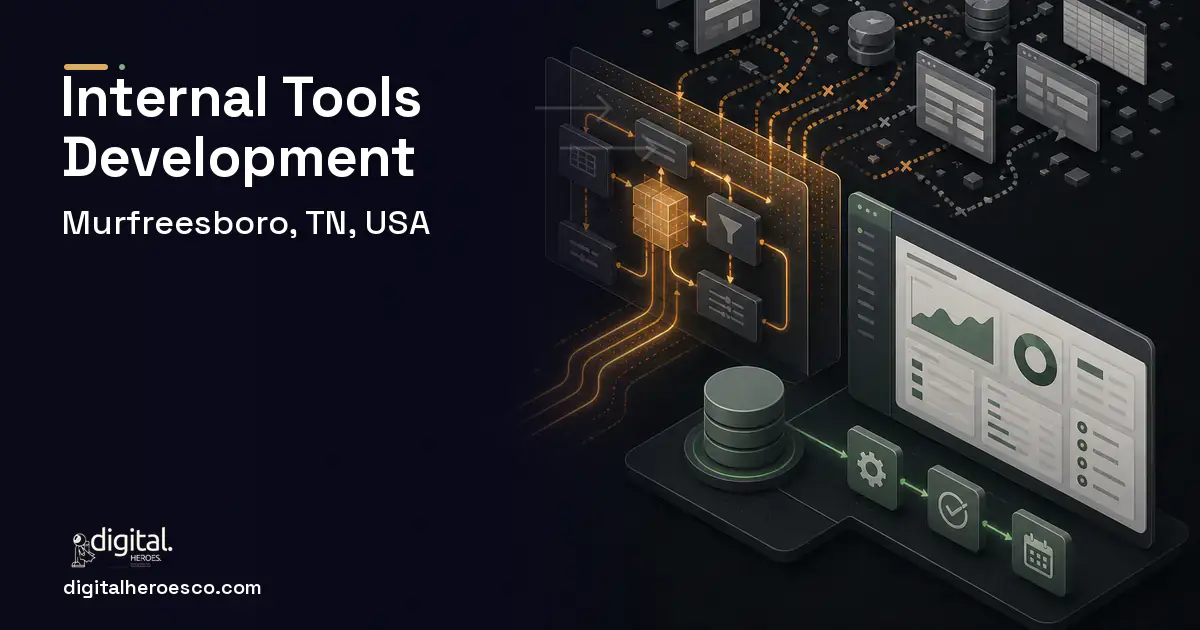
Internal tools are the admin screens, dashboards, and approval flows that run a Murfreesboro plant or distribution floor without a packaged product doing it. In our delivery experience, a focused internal tool runs $20,000 to $70,000 over 6 to 16 weeks, far less than a full ERP (Enterprise Resource Planning), and it replaces the fragile Retool app or Airtable base that one person quietly holds together. You get software your ops team actually owns.
Somewhere between your ERP and your email lives the real work: a spreadsheet that assigns pick lists, an Airtable base that tracks returns, a Retool screen someone built on a weekend to approve overtime. It works until the person who built it leaves, or until you cross Airtable's row ceiling, or until Retool's per-user pricing turns a five-person tool into a real line item. Then the operation depends on something nobody can fully explain.
Off-the-shelf builders are great for a prototype and terrible as the backbone of a growing Rutherford County operation. Retool locks logic inside a platform you cannot easily export, Airtable was never a transactional database, and spreadsheets have no permissions, no audit trail, and no guardrails. When a tool starts touching inventory, money, or shipments, its quiet limits become your outages.
What breaks first in Murfreesboro
- A single Airtable base is past its row limit and slows to a crawl during the morning shift
- The Retool app that approves overtime and reassigns picks has exactly one person who understands it
- No audit trail, so when an inventory adjustment goes wrong nobody can say who changed what
- Per-user Retool pricing punishes you every time you add a floor lead who needs access
The fix: internal tools built for Murfreesboro, not rented
Custom internal tools make sense when a screen has quietly become load-bearing. A build gives you a real database with permissions and an audit log, an interface designed for the floor rather than a generic grid, and logic in code your team can read and extend. For a supplier or distributor, that turns a fragile weekend app into infrastructure that survives turnover. The tools sit cleanly on top of your ERP and inventory system instead of duplicating them.
What internal tools costs in Murfreesboro
| Project scope | Typical cost | Timeline |
|---|---|---|
| Single-purpose internal tool | $20,000 to $35,000 | 6 to 10 weeks |
| Multi-screen ops app with approvals | $35,000 to $55,000 | 10 to 14 weeks |
| Integrated floor suite with scanning | $55,000 to $80,000 | 14 to 20 weeks |
The capability list that earns its budget
Internal Tools services we deliver in Murfreesboro
Digital Heroes builds the full internal tools stack for Murfreesboro teams. Typical engagements cover Retool alternative, workflow automation, back-office software, operations tooling and approval workflows.
Exactly what you get
You get the specific screens your operation runs on, rebuilt on a real database with permissions, an audit trail, and scanner-friendly interfaces. Approvals, adjustments, and pick assignments become accountable actions, not spreadsheet edits. Everything reads and writes to your ERP and warehouse system so there is one source of truth, and shift leads get live dashboards instead of a stale export.
How to choose a developer in Murfreesboro
Look for a team that treats internal tools as real software: database design, permissions, audit logging, and documentation, not just a prettier grid. Ask how they will migrate your Airtable or Retool logic and whether the result runs offline in a warehouse dead spot. A partner who can integrate with your inventory and accounting systems keeps you off another island. Insist on documentation so no single person becomes the failure point again.
- !They rebuild it in another no-code tool and call it a solution. Ask what you own and can export
- !No audit logging on writes that touch stock or money. Ask how a bad adjustment gets traced
- !They skip integration and hand you another island. Ask how it reads your ERP live
- !They ignore the dead-zone reality of a big building. Ask how the tool behaves offline
- !No documentation plan. Ask what happens when their developer moves on
Teams investing in internal tools in Murfreesboro usually scope it next to custom software, wordpress, accounting, since these systems share data and budgets. Weighing options across the region? Nearby: internal tools in Nashville, Memphis and Knoxville. Want it built, not just budgeted? That is our custom software development practice.
The evidence behind this guide
Independent findings on why this investment pays off. Every link goes to the primary source.
- McKinsey found that tech debt can amount to 20-40% of the value of a company's entire technology estate before depreciation, and CIOs report that 10-20% of the budget for new products is diverted to resolving tech-debt issues. Source: McKinsey & Company (2020) →
- SaaS spend averaged $4,830 per employee (up 21.9% year over year), with large enterprises (10,000+ employees) spending roughly $284M annually and running about 660 apps, while organizations wasted an average of $21M annually on unused licenses. Source: Zylo (2025) →
- Only 22% of firms are 'future ready' having significantly transformed digitally; these companies show average revenue growth 17.3 percentage points and net margins 14.0 percentage points above their industry average. Source: MIT Center for Information Systems Research (MIT Sloan) (2022) →
- SHRM's 2025 benchmarking data puts the average cost-per-hire at $5,475 for nonexecutive roles and $35,879 for executive roles - executive hires are on average nearly 7x more expensive than nonexecutive hires. Source: SHRM (Society for Human Resource Management) (2025) →
Frequently asked questions
What does an internal tool cost to build in Murfreesboro?
A single-purpose tool runs $20,000 to $35,000, and a multi-screen operations app with approvals and scanning runs $35,000 to $55,000. Most land in 6 to 16 weeks. That is a fraction of a full ERP because the scope is one workflow, not the whole business.
We built our tool in Retool. Why replace it?
Replace it when it has become critical and depends on one person, when per-user pricing is biting, or when you have hit a logic or performance wall. We can rebuild the same workflow on a database you own, with an audit trail and documentation, so it survives turnover.
Can the tool work on shop-floor tablets and scanners?
Yes. We design scanner-friendly screens for receiving, picking, and cycle counts, and we account for offline behavior in the dead corners of a large Rutherford County building. The interface is built for a floor lead moving fast, not a desk.
Will it connect to our ERP and inventory system?
Yes, directly. Because you own both ends, the tool reads and writes live to your ERP and inventory management software, so no one exports and re-imports between apps.
How do we avoid a pile of one-off tools later?
Assign one internal owner for the roadmap and build on a shared foundation so screens reuse the same database and auth. We set that structure up front, which is exactly what a pile of Airtable bases never had.
Can local developers maintain it?
Yes. We build on mainstream frameworks and document the code, and the MTSU and Nashville developer market gives you real hiring options. That is a deliberate contrast to a no-code platform where the logic is locked inside a vendor.
How long until the floor is using it?
A focused tool is usually in floor hands within 6 to 10 weeks, and we pilot it on one shift before rolling wider. That keeps adoption honest and surfaces real-world issues before everyone depends on it.
Is custom overkill for a simple tracker?
Often, yes. If the tool is low-stakes and Airtable handles the row count, keep it there. Custom earns its cost once the tool touches inventory, money, or shipments and needs permissions and an audit trail.
What about an audit trail for inventory changes?
Every write is logged with who, what, and when, so a bad stock adjustment is traceable in seconds. Spreadsheets and most no-code bases cannot give you that, which is usually the reason a growing supplier finally moves to custom.
What tech stack should an internal tool be built with?
Boring and popular: a React or Next.js frontend, a Node.js or Python backend, and PostgreSQL covers the vast majority of internal tools and keeps future hiring easy. The stack matters far less than whether a different developer can pick the code up in two years, so require documentation as a deliverable and avoid anything exotic. Treat it as a red flag if an agency pushes a proprietary platform only they maintain, because that quietly converts your tool into a subscription to that agency.
Will a custom internal tool scale as our company grows?
Yes, provided it sits on a standard stack with a real database: PostgreSQL comfortably handles millions of records, and adding users costs hosting pennies rather than per-seat fees. The real scaling risks are organizational, not technical: new departments want features, processes change, and the tool needs a budget line to evolve. Set aside a small quarterly improvement budget instead of treating launch as the finish line, and the tool stays useful for a decade rather than getting rebuilt every two years.
How much should a small business budget for its first custom app or website?
For a focused first build, most small businesses land between $8,000 and $60,000: roughly $8,000 to $45,000 for a custom website and $25,000 to $60,000 for an internal tool or simple web app, based on Digital Heroes delivery across 2,000+ projects. Customer-facing products with payments, logins, or a mobile app start around $40,000. Quotes far below these bands usually mean a template with your logo on it, not software shaped around your workflow.
Is a custom internal tool secure enough for HR records and financial data?
A properly built custom tool is generally safer for sensitive data than the shared spreadsheet it replaces, because you get role-based access, audit logs, encrypted storage, and the ability to cut one person's access instantly. Ask the agency specifically for encryption in transit and at rest, permissions down to the field level, and an audit trail showing who viewed or changed each record. If HIPAA, GDPR, or SOC 2 expectations from enterprise clients apply to you, raise it before the quote, because compliance features add real scope.
Can a custom internal tool connect to QuickBooks, Salesforce, and the other software we already use?
Yes, and integrations are usually the strongest argument for going custom instead of chaining tools together with Zapier. QuickBooks, Salesforce, Shopify, Stripe, Slack, and Google Workspace all have mature APIs, and each integration typically adds $1,500 to $5,000 to a Digital Heroes build depending on how much two-way syncing you need. The honest caveat is legacy industry software without an API, which may need file-based imports instead of a live connection, so list every system in the first conversation.
Is a freelancer or an agency better for building an internal tool?
A solid freelancer works for a single-workflow tool under roughly $10,000, if you accept that one person holds all the knowledge. An agency earns its premium once the tool spans departments or integrations, because you get a developer, a designer, and a project manager plus continuity when someone leaves or gets sick. The hidden freelancer cost appears 18 months later when you need changes and the original builder has moved on, a rescue situation Digital Heroes is hired for regularly.
Should I hire a freelancer or an agency for my software project?
A skilled freelancer is the right call for a single-discipline scope under roughly $15,000, like a website, a plugin, or one integration. Above that, projects need design, backend, testing, and project management at once, and a solo builder becomes the single point of failure: if they get sick or take a bigger client, your project simply stops. Agencies bill 20-40% more per hour but carry continuity, code review, and someone to escalate to, which is what you are actually buying.
What does it cost to keep an internal tool running after launch, and do we need to hire a developer?
Budget 15 to 20 percent of the build cost per year, so a $25,000 tool runs roughly $300 to $400 a month covering hosting, security patches, dependency updates, and small tweaks, figures drawn from Digital Heroes maintenance contracts. You do not need an in-house developer; a monthly retainer with the agency that built it covers the typical internal tool comfortably. Hosting itself is cheap for internal audiences, often $20 to $100 a month, because you serve dozens of users rather than the open internet.
How do I know when spreadsheets are no longer enough to run my operations?
Replace the spreadsheet once more than three people edit it, versions travel by email, or a single broken formula could cost real money. Other reliable signals: staff keep personal shadow copies, month-end reporting takes days of manual assembly, and nobody can say who changed a number or why. In Digital Heroes discovery calls the tipping point is almost always a specific expensive error, a mispriced quote, a missed order, or payroll built on a tab someone sorted wrong.
Who can build custom internal tools for a business in Murfreesboro?
Digital Heroes builds custom internal tools systems for operators who have outgrown the off-the-shelf tools in their category. The work is delivered remotely: our engineers work from Delhi and Lucknow, leadership is in New York, and some team members live in London and Sydney and work remotely from there. We have no office in Murfreesboro. You can chat with the team directly, and every form gets an email reply within 24 hours.
Related guides
Published · Last updated .