QuickBooks handles your Moncton books until freight billing and bilingual invoices break it
Custom accounting software for a Moncton business typically costs $45k to $130k CAD and ships in 12 to 20 weeks.
On this page
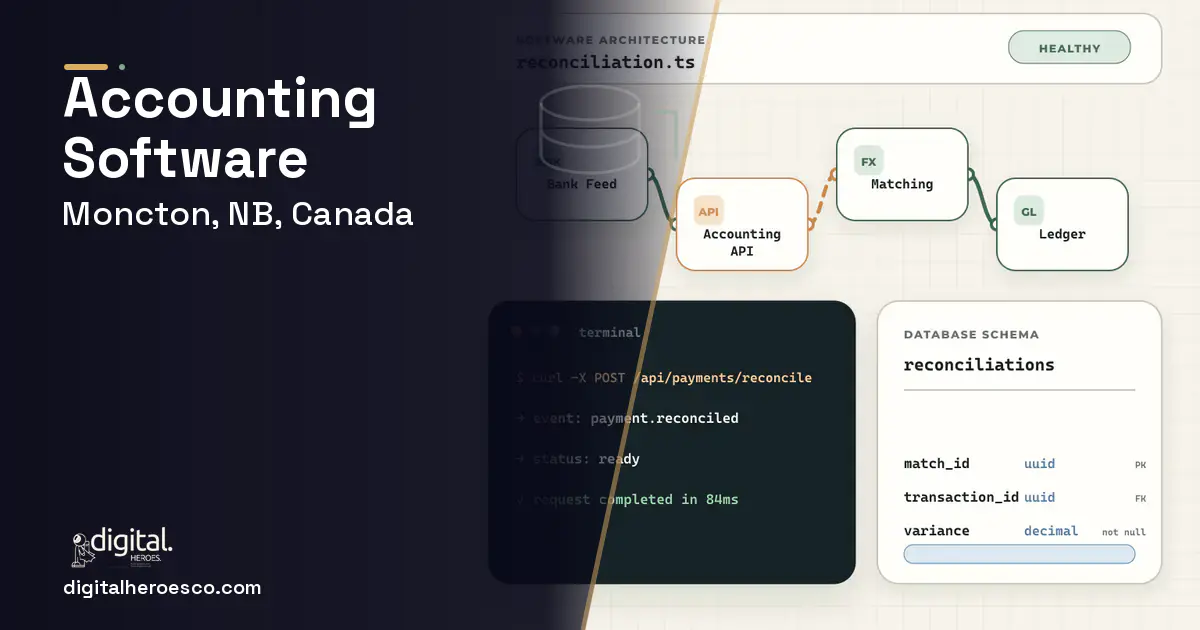
Custom accounting software for a Moncton business typically costs $45k to $130k CAD and ships in 12 to 20 weeks. You build when QuickBooks or Xero cannot handle freight billing, interline HST or bilingual invoicing at your scale, when reporting needs are beyond a standard chart of accounts, and when accounting must integrate deeply with dispatch, inventory and payroll. Custom accounting software fits a Moncton operator's real financial flow rather than a generic small-business template.
Your Moncton books started on QuickBooks and it worked, until the business got specific. Freight billing across the Maritimes, interline HST at 15%, and account-based pricing for distribution customers strain a tool built for straightforward small-business bookkeeping. Bilingual invoicing is the daily reminder: a French account needs a French invoice, an English account needs English, and QuickBooks ties that to settings rather than to the customer, so someone edits every invoice by hand.
Xero and FreshBooks have the same ceiling. They are excellent for simple operations and increasingly awkward as your reporting, tax and integration needs grow. You end up exporting to spreadsheets to answer basic questions about lane profitability or client margins, and reconciling between accounting, dispatch and inventory by hand, which is slow and error-prone at month-end.
Where the off-the-shelf tools fall short
- Freight billing and interline HST at 15% strain QuickBooks and Xero
- Bilingual invoicing is manual because language follows settings, not the customer
- Reporting on lane profitability or client margins needs spreadsheet exports
- Accounting, dispatch and inventory reconcile by hand at month-end
Custom accounting: what Moncton teams actually get
Custom accounting software encodes your real financial logic: freight and interline billing, HST 15%, and per-customer bilingual invoicing that renders EN or FR from the account record. It reports the questions you actually ask, by lane and by client, and it integrates with your ERP (Enterprise Resource Planning), inventory and payroll so month-end is a scheduled close, not a reconciliation marathon. It stays aligned with CRA record-keeping so audits are straightforward.
- Freight billing and interline HST strain your current accounting tool
- Bilingual invoicing is a manual per-invoice edit
- You export to spreadsheets to answer basic profitability questions
- Month-end is a hand reconciliation across several systems
- Your bookkeeping is straightforward and single-language
- QuickBooks or Xero already answers your reporting questions
- You have no complex freight, interline or account-billing logic
- You need accounting running now with minimal setup
- Freight, interline and HST 15% billing handled natively, not worked around
- Per-customer bilingual invoicing that renders EN or FR automatically
- Reporting by lane and by client, without spreadsheet exports
- Deep integration with dispatch, inventory and payroll for a clean close
- CRA-aligned record-keeping that makes audits straightforward
- Accounting is a 12 to 20 week build and demands precise, tested logic
- You own maintenance and must track CRA and tax changes
- Simple bookkeeping is genuinely well served by QuickBooks or Xero
- Migrating financial history requires careful validation
Feature priorities for Moncton teams
What we build under accounting in Moncton
Digital Heroes builds the full accounting stack for Moncton teams. Typical engagements cover accounts payable automation, accounts receivable, general ledger, expense management, custom accounting software and QuickBooks integration.
The honest cost picture for Moncton
| Project scope | Typical cost | Timeline |
|---|---|---|
| Bilingual invoicing and HST core | $45k to $68k | 12 to 14 weeks |
| Add freight billing and profitability reporting | $68k to $100k | 14 to 17 weeks |
| Full accounting with ERP and payroll integration | $100k to $130k | 17 to 20 weeks |
Timeline: what happens, and when
Exactly what you get
You get accounting software built around your real financial flow: per-customer bilingual invoicing, HST 15% and interline freight tax, and reporting by lane and client. It integrates with your ERP, inventory and payroll so month-end is a scheduled close, and it keeps CRA-aligned audit trails. You own the code and schema, get a validated migration of your financial history, and documentation so any Moncton developer can maintain this sensitive system.
How to choose a developer in Moncton
Because this system holds your financials, insist on a team that can speak precisely about HST 15%, interline freight tax and CRA record-keeping, and that can show per-customer bilingual invoicing working live. Ask how they migrate and validate your financial history, since opening balances must reconcile to the penny before go-live. Confirm the accounting integrates with dispatch, inventory and payroll so month-end is genuinely faster, and demand code ownership in writing. A strong Moncton partner will phase the build, proving invoicing and HST before wiring in the deeper integrations, and will tell you honestly if QuickBooks still fits.
- !They treat bilingual invoicing as a setting. Ask how a French account gets a French invoice automatically
- !They cannot speak to interline HST. Ask for a Maritime freight tax example
- !They skip a reconciliation plan for migrated history. Ask how they validate opening balances
- !They ignore integrations. Ask how month-end close pulls from dispatch and inventory
- !They keep the code for a system holding your financials. Ask for ownership in writing
Most Moncton teams pricing accounting end up comparing notes on warehouse management, field service management, erp too; the systems share one data spine. Weighing options across the region? Nearby: accounting in Saint John and Fredericton. Prefer to talk to the team that builds these? Digital Heroes handles custom software development end to end.
The evidence behind this guide
Independent findings on why this investment pays off. Every link goes to the primary source.
- Gartner estimates RPA can eliminate up to 25,000 hours of avoidable rework caused by human errors in the finance function each year, equating to savings of roughly $878,000 for an organization with 40 full-time accounting staff (based on interviews with more than 150 corporate controllers and chief accounting officers). Source: Gartner (2019) →
- McKinsey found that currently demonstrated technologies can fully automate about 42% of finance activities and mostly automate a further 19%, indicating roughly 60% of finance work is technically automatable. Source: McKinsey & Company (2018) →
- 48% of private companies cite integration with legacy systems or technical debt as a top obstacle to realizing the full value of their digital and AI investments (behind data quality/availability at 72% and gaps in AI fluency or technology talent/leadership at 53%). Source: Deloitte (2026) →
- SaaS spend averaged $4,830 per employee (up 21.9% year over year), with large enterprises (10,000+ employees) spending roughly $284M annually and running about 660 apps, while organizations wasted an average of $21M annually on unused licenses. Source: Zylo (2025) →
Frequently asked questions
What does custom accounting software cost for a Moncton business?
Custom accounting software for a Moncton business runs $45k to $130k CAD. A bilingual invoicing and HST core starts near $45k, adding freight billing and profitability reporting runs $68k to $100k, and a full build integrated with ERP and payroll reaches $130k. Most Moncton builds land between $70k and $105k.
Can it produce French invoices for French accounts automatically?
Yes. The system renders EN or FR invoices from the customer record, so a French-speaking Moncton account automatically receives a French invoice while an English account gets English, with no per-invoice editing. QuickBooks and Xero tie language to settings rather than the customer, which is why bilingual invoicing becomes manual on those tools.
How does it handle HST at 15% and freight interlined across the Maritimes?
We build New Brunswick HST at 15% and interline freight tax directly into the accounting logic, so tax on shipments moving between NB, Nova Scotia and PEI reconciles correctly. This removes the monthly spreadsheet fix-up that off-the-shelf tools force on Maritime distributors.
How long does an accounting build take, and can we migrate our history?
Expect 12 to 20 weeks, with most Moncton builds live around week 16. We migrate your financial history and validate opening balances to the penny before go-live, running parallel with your current system until the numbers reconcile. Nothing cuts over until the migration is proven.
Can it report on lane and client profitability?
Yes. We build reporting around the questions you actually ask, such as profitability by freight lane or by distribution client, rather than a generic chart of accounts. This ends the spreadsheet exports Moncton operators rely on to answer basic margin questions in QuickBooks.
Will it integrate with our dispatch, inventory and payroll?
Yes. We integrate accounting with your ERP, dispatch, inventory and payroll so month-end is a scheduled close rather than a hand reconciliation across systems. Costs, revenue and hours flow in automatically, which is where most of the time savings come from.
Do we own the accounting software given it holds our financials?
Yes. You own the source code and schema outright, which matters for a system holding your financial data. It is written into the contract, any Moncton developer can maintain it, and you control hosting in line with PIPEDA and CRA retention requirements.
How do you keep it current with CRA and tax changes?
A maintenance retainer keeps HST, interline tax and CRA record-keeping current, along with security updates. Because you own the code, you can handle this in-house or with us and are never waiting on a vendor's release cycle for a compliance change that affects your remittance.
Is QuickBooks or Xero ever the right choice for a Moncton business?
Yes. For straightforward, single-language bookkeeping without complex freight or interline logic, QuickBooks or Xero is cheaper and entirely adequate, and we will tell you so. Custom accounting earns its cost when bilingual invoicing, HST interline tax, profitability reporting and deep integration become the daily friction, which is common for Maritime distribution and shared-service firms.
Can custom accounting software connect to my bank, payment processor, and payroll provider?
Yes, and it should be treated as standard scope rather than an add-on. Bank feeds typically come through aggregators like Plaid, payments through Stripe or your existing processor's API, and payroll providers such as Gusto and ADP publish APIs for pulling journal entries. The real constraint is smaller regional banks without feed coverage, which is worth verifying during scoping instead of discovering after launch.
What happens to my software if the agency shuts down or we stop working together?
Nothing dramatic, if the engagement was set up correctly: the code sits in your repository, hosting runs on your cloud account, and a handover document explains how to deploy and operate the system. Any competent replacement team can then take over in days rather than months. If the agency controls the repo, the servers, or the domain, fix that now, because renegotiating access during a dispute is the most expensive place to discover the problem.
Does my development team need to be located in Moncton?
No, most software projects run fully remote without any quality penalty, and what actually matters is 3 to 4 hours of working-hour overlap and a fixed weekly demo call. A team based in Moncton earns its premium in specific cases: hardware installations, warehouse or clinic floor shadowing, and discovery workshops where watching your staff work beats any written brief. Choose for senior engineers and a track record first, and treat geography as a tiebreaker.
How many people should be working on my software project?
Three to five for a typical focused build: a project lead, one or two engineers, a designer, and part-time QA, which is the standard shape across 2,000+ Digital Heroes projects. Larger platforms justify 6 to 10, but a ten-person team on a small first version usually signals bill padding rather than horsepower. What predicts success is whether a senior engineer is writing your code daily, not the headcount on the proposal.
How long does it take to build custom accounting software?
A focused first version takes 10 to 16 weeks, and a complete QuickBooks-class replacement takes 6 to 9 months. In Digital Heroes delivery data, schedules slip most often during data migration and bank feed integration, so we budget those two phases at double the first estimate. Treat any promise of a full accounting system in under two months as a warning sign.
Should the first version of my accounting software be an MVP?
Yes, but scope it around one complete workflow rather than a thin slice of everything. A strong first release fully owns, say, invoicing and receivables while QuickBooks keeps running the general ledger, letting you validate the software with real money movement in 10 to 14 weeks. In Digital Heroes projects, one-workflow MVPs reach a stable full system faster than big-bang replacements almost every time.
How long does it take to build a custom web or mobile app from scratch?
Plan on 8 to 16 weeks for a focused first version and 4 to 9 months for a larger platform, which is the typical spread across Digital Heroes builds. The first 2 to 3 weeks go to discovery and design before any production code ships. The two things that stretch timelines most are integrations with legacy systems and slow feedback from your side, not developer speed.
What are the biggest mistakes first-time software buyers make?
Choosing the lowest bid, paying more than 30-40% upfront instead of on milestones, skipping a written specification, and having no maintenance plan for after launch. The most expensive of the four in Digital Heroes rescue projects is the missing spec: without written acceptance criteria, done becomes an argument instead of a checklist, and every disagreement resolves in the vendor's favor. Fix those four and you have avoided most of the ways these projects fail.
Can I extend QuickBooks with custom features instead of replacing it?
Yes, and it is often the right first step. QuickBooks Online has a public API, so an agency can build a custom layer for quoting, inventory, or field service that pushes clean transactions into QuickBooks, which stays your ledger of record. Roughly half of the accounting engagements Digital Heroes scopes start this way because it costs a fraction of a full build and leaves your accountant's workflow untouched.
Should I hire a freelancer or an agency to build my accounting software?
A strong freelancer is fine for a reporting dashboard or one integration; anything that holds your books needs a team. Ledger software requires backend, frontend, QA, and accounting domain knowledge, and one person rarely covers all four while staying available for the 5 to 10 year life of the system. The most common rescue job Digital Heroes takes on is a solo-built ledger with no tests and no documentation after the freelancer moved on.
Who can build custom accounting software for a business in Moncton?
Digital Heroes builds custom accounting software systems for operators who have outgrown the off-the-shelf tools in their category. The work is delivered remotely: our engineers work from Delhi and Lucknow, leadership is in New York, and some team members live in London and Sydney and work remotely from there. We have no office in Moncton. You can chat with the team directly, and every form gets an email reply within 24 hours.
Related guides

More from Tanvi.
QA Lead · Shopify · Delhi · 1 post on the site
Published · Last updated .